

By Genius IT Foundation | February 2026
Every ten seconds, another young African enters the labour market seeking employment. By the time you finish reading this article, dozens more will have joined the queue — a queue that, according to the just-released Africa Youth Employment Outlook 2026, is already overwhelmed.
The report, produced by the World Data Lab in partnership with the Mastercard Foundation and the University of Cape Town’s Development Policy Research Unit, was launched on 10 February 2026. It carries a message that should concern every parent, teacher, policymaker, and business leader on this continent: Africa is home to 550 million young people between the ages of 15 and 35 — more than 22% of the world’s entire youth population. Yet each year, over 10 million of them enter a labour market that creates only around 3 million formal jobs. The arithmetic is brutal. And it is getting worse.
This is not a distant, abstract problem. It is happening right now, in our schools, in our communities, in our homes. And it is why the Genius IT Foundation exists.
We Have More Youth Than We Have Futures Planned For
Hannah Tsadik, Kenya Country Director at the Mastercard Foundation, put it plainly at the report’s launch: we must move beyond getting young people any work, to ensuring they access dignified and fulfilling work. That shift — from survival employment to meaningful careers — does not happen by accident. It requires deliberate preparation, and it has to start early.
Here is where the conversation gets uncomfortable. Africa’s youthfulness is celebrated as a demographic dividend, and rightly so. But a dividend only pays out if it is invested wisely. Right now, a large portion of Africa’s youth are entering the workforce underprepared — not because they are not intelligent or hardworking, but because the systems designed to prepare them were built for a world that no longer exists.
The Africa Youth Employment Outlook 2026 identifies three major shifts currently reshaping the continent’s labour market. Young Africans aged 15 to 17 are entering the workforce before finishing school, taking low-paying, informal agricultural jobs. By 2033, the services sector will overtake agriculture as the primary employer of young people for the first time in history — and those jobs will pay 2.6 times more than farming. And urbanisation is accelerating everything, pulling youth employment from rural areas into cities at a pace our urban infrastructure is not yet ready to absorb.
These are not just statistics. They are a roadmap. And they tell us two things clearly: the nature of work is changing fast, and formal education alone is not equipped to keep up.
The Gap Between Knowing and Doing
There is a difference between knowledge and skill that we do not talk about enough. Knowledge can be transferred relatively quickly — you can explain a concept in a classroom, share a video online, or walk someone through a theory in an afternoon. Skill is different. Skill is built through repetition, through getting your hands on something, through making mistakes, through doing. It takes time. It takes consistent, guided practice.
This is the gap that defines the crisis facing African youth today. Our education systems have done a reasonable job of passing on knowledge. What they have not kept up with is skills — particularly practical, digital, and entrepreneurial skills that map directly onto the economy that is arriving.
The world is not waiting for us to catch up. Technology is moving. The digital economy is expanding. Artificial intelligence, cybersecurity, data analytics, and digital entrepreneurship — these are no longer niche interests for tech enthusiasts. They are fast becoming the baseline requirements for meaningful participation in the modern economy.
If we do not get ahead of this gap — and get ahead of it urgently — we risk something deeply uncomfortable: a generation of young Africans who are well-educated by old standards, but chronically underprepared for the economy they are actually stepping into. A generation whose intellectual energy and potential is directed not by themselves, but by the few — local and foreign — who understood how the new systems work and moved to control them first.
That is not a future anyone working in education or development can accept.
The FUTECH KIDS Response: Start Before It Is Too Late
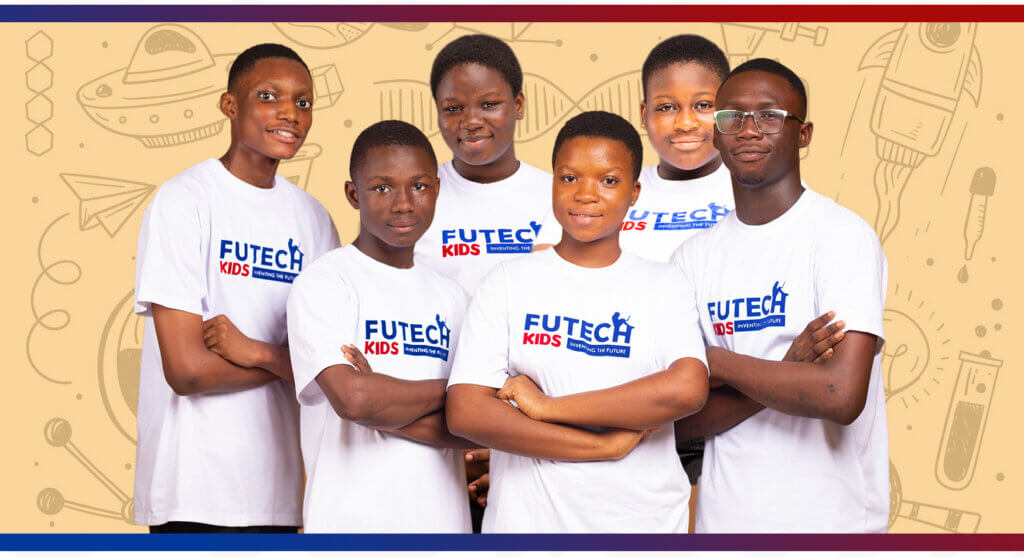
The Genius IT Foundation’s approach, captured in its FUTECH KIDS programme, is built on a simple but powerful conviction: if skill-building takes longer than knowledge transfer, then we cannot afford to start late. We have to begin with children.
FUTECH KIDS is an early-exposure digital skills programme designed for school-going children in Ghana. It operates on the premise that introducing children to digital tools, computational thinking, entrepreneurial mindsets, and leadership fundamentals at a young age creates a foundation that formal schooling can then build on — rather than the other way around. It is not about replacing school. It is about starting the skills journey earlier, so that by the time these children graduate, they are not starting from zero.
Think of it this way: a child who has been coding since age ten does not approach an ICT class the same way as one who sees a keyboard for the first time at university. A teenager who has been taught to think like an entrepreneur understands business fundamentals in ways that no classroom lecture alone can replicate. The exposure itself is the education.
FUTECH KIDS directly answers the first shift identified in the Mastercard Foundation report — the alarming trend of young Africans dropping out of school early to work, because they see no connection between their education and the economic realities they face. When children experience digital skills as something that opens doors rather than just something on an examination syllabus, school becomes more relevant. The future becomes more visible.
Beyond Digital: Leadership, Entrepreneurship, and Ownership

The Genius IT Foundation’s broader mission is structured around three pillars: Digital Skills, Entrepreneurship, and Leadership. This combination is not accidental.
Digital skills without entrepreneurial thinking produce employees who are perpetually dependent on someone else to create the opportunity. Entrepreneurial thinking without digital fluency means building businesses that are always behind the technology curve. And neither means very much without leadership — the capacity to see a problem, take responsibility for it, and guide others toward a solution.
Together, these three pillars are designed to produce something more than a skilled job-seeker. They are designed to produce young Africans who build things, lead teams, create enterprises, and ultimately direct their own economic futures rather than waiting for someone else to define those futures for them.
This matters because the *Africa Youth Employment Outlook 2026* is not just a report about jobs. It is a report about power — about who gets to shape Africa’s economy and who simply participates in it on someone else’s terms. The Mastercard Foundation’s Young Africa Works strategy is itself aiming to enable 30 million young people to access dignified employment, with 70% of that goal focused on young women. The goal is not just employment. It is agency.
Genius IT Foundation shares that goal entirely. Our programmes, from cybersecurity awareness to digital entrepreneurship, from coding workshops to leadership coaching, are designed with one north star: helping young Ghanaians understand how systems work, so they can build and lead those systems rather than simply be managed by them.
Complementing, Not Competing With, Formal Education
It is worth being clear about something. Nothing in the Genius IT Foundation’s work is designed to suggest that formal education is irrelevant or that school should be bypassed. The opposite is true. What the FUTECH KIDS programme and our broader initiatives are designed to do is complement formal schooling — filling the gaps that curricula are often too slow to address, and providing the practical skills runway that children need alongside their academic development.
Ghana’s education system has produced extraordinary minds. What our young people increasingly need is for those minds to be matched with hands — with the practical confidence to take what they know and build something real with it. That is what skills exposure does. It connects theory to practice, and it makes the future feel possible rather than abstract.
The Mastercard Foundation’s own research underscores that modernising education and skills to align with market needs is one of the five key areas required to meaningfully address youth unemployment across Africa. We are not working in isolation. We are working in the direction that the evidence points.
The Time to Act Is Already Behind Us
The Africa Youth Employment Outlook 2026 projects that Sub-Saharan Africa will need to create 15 million new jobs every year just to absorb new labour market entrants by 2030. That is an almost incomprehensible number. No single government, foundation, or institution can solve it alone.
But here is what we do know: the young people who will fill those jobs — or create them — are in school right now. They are sitting in classrooms in Ho, Accra, Kumasi, Takoradi, and Tamale. They are curious. They are capable. And what they are most in need of is not more lectures about what the future might look like, but real, hands-on experience with the tools and thinking that will define it.
That is what Genius IT Foundation is here to provide. Not because the work is easy, or because the resources are always abundant, but because the alternative — a generation of brilliant young Africans who were never given the chance to fully realise their potential — is not something we are willing to accept.
Africa’s demographic moment is real. Its potential is real. The question is whether we will invest in it seriously enough, and early enough, to turn it into the future it deserves to be.
The Africa Youth Employment Outlook 2026 was produced by the World Data Lab in partnership with the Mastercard Foundation and the University of Cape Town’s Development Policy Research Unit. It was launched on 10 February 2026 and is available at: mastercardfdn.org/en/our-research/africa-youth-employment-outlook-2026
The Genius IT Foundation is a Ghanaian organisation committed to expanding access to digital skills, entrepreneurship education, and leadership development for young people across Ghana and Africa. Learn more about the FUTECH KIDS programme and other initiatives at geniusitfoundation.org

